.svg)
.svg)
.png)
.png)
.svg)
.svg)

.svg)
.svg)
.svg)
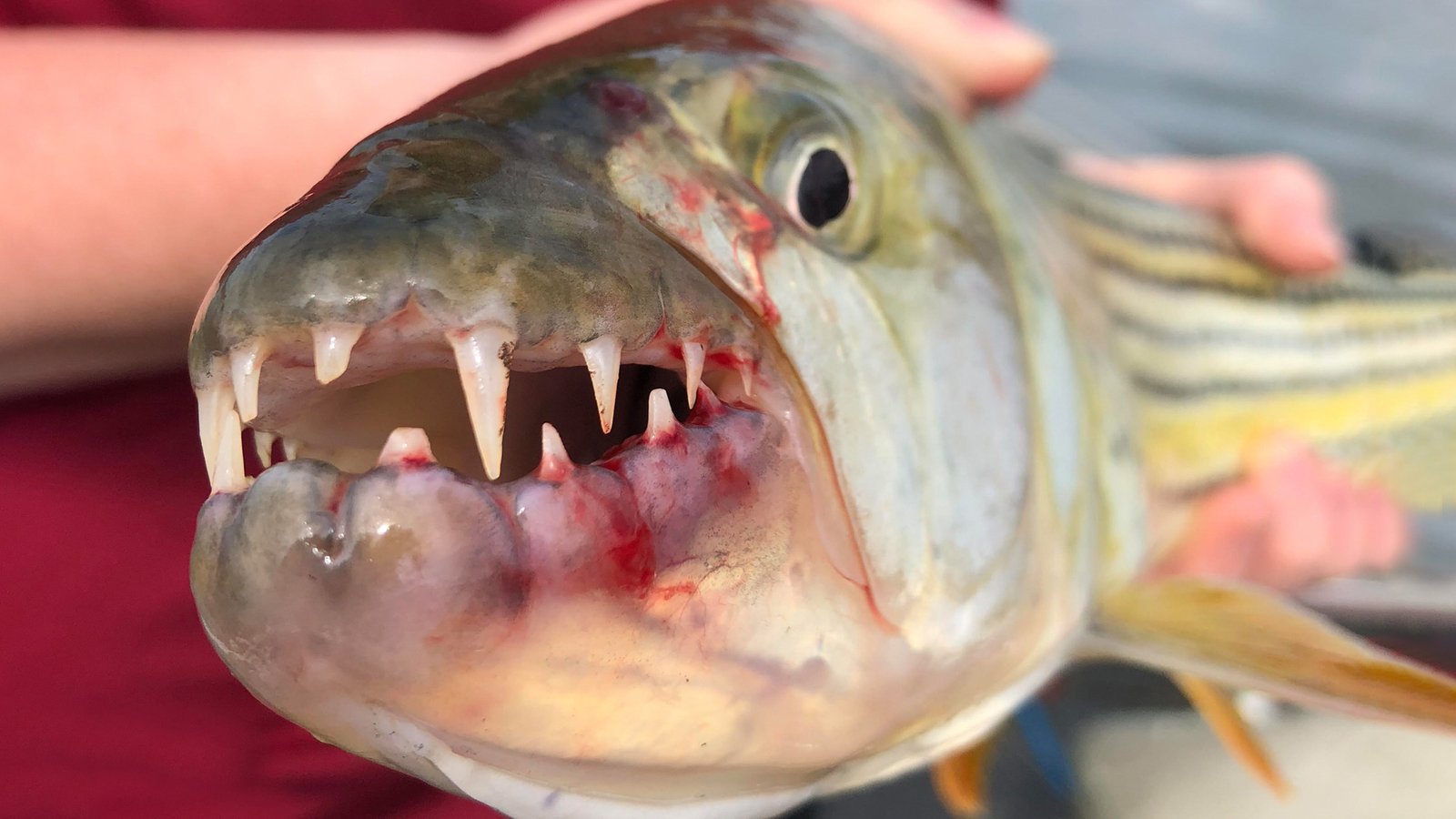

When planning a fishing trip on the great Zambezi River for African tigerfish, you’ll find there’s more to consider than simply keeping your hands inside the boat around hungry crocodiles and moving spots at the first sign of hippos. Fishing the Zambezi during Africa’s rainy season comes with its own set of challenges, rewards and lessons. But on our first trip to Africa, some of the most memorable lessons had surprisingly little to do with catching fish.

The Trip Begins
There we were – across the pond, and not in the way most people mean it. As a child who drooled over Zoobooks commercials and ran around the yard in my underwear playing Tarzan, Lord of the Jungle, I’d always dreamed of coming to Africa. But somehow, the Africa I’d imagined and the one we’d encountered in our first few days on the ground didn’t seem to align. It’s easy to get swept up in the romance of khaki clothes and safari helmets, surrounded by savanna grasslands and the occasional wandering elephant or zebra. It’s not until you get there that you realize just how far off that fantasy strays from reality.
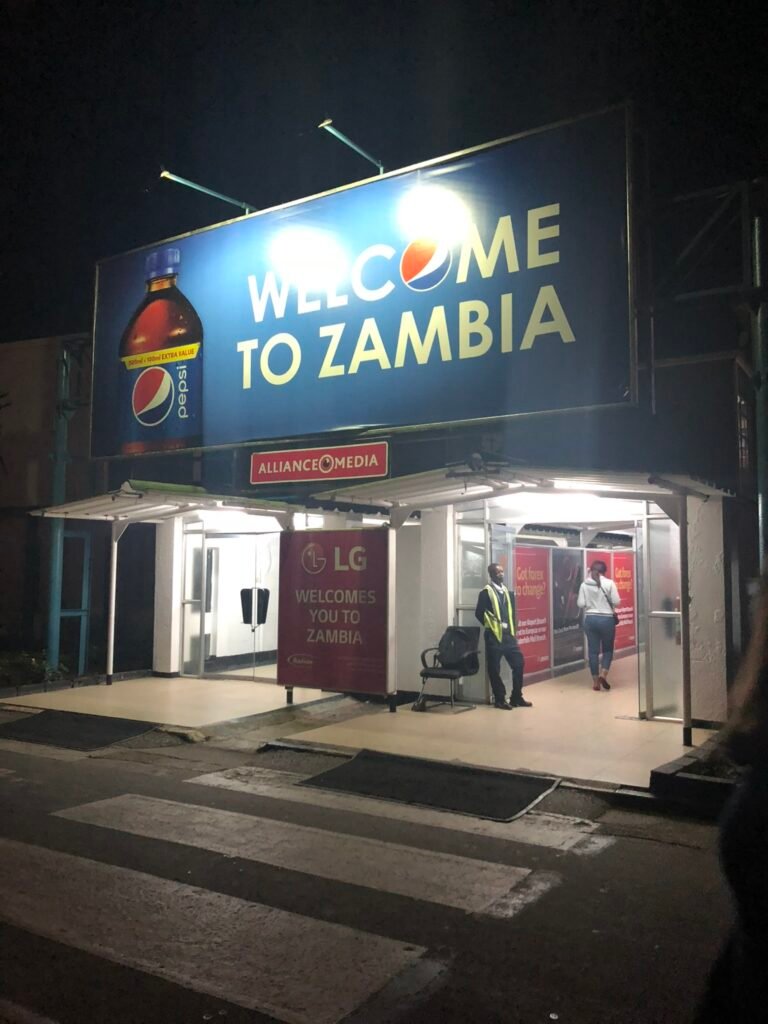
We flew into the country’s capital of Lusaka late. The blackened night sky seemed darker than usual as exploding bouquets of fireworks lit the clouds below our plane like a smoke-filled light show at a concert. It wasn’t our plan to arrive just after midnight on New Year’s Day, 2019, but after nearly 22 hours of flying, I think we were just excited to be on the ground.

Although my wife, Alicen (still my girlfriend at the time), had ventured to Europe with a school group back in secondary, neither of us would have described ourselves as seasoned international travelers. Alicen was headed to Zambia for a seven-week clinical rotation, which gave us an excuse to arrive two weeks early and make a trip of it. I was mostly along for the ride, fulfilling a childhood dream of finally seeing Africa… and in the process, becoming the first in my family to travel abroad without the military ordering me to do so.
Grabbing our bags and stepping outside the airport, we were met by a pitch-black parking lot, lit only by a handful of weak street lamps scattered throughout. This was the moment the fear finally started to seep in. We were in a foreign land with no working phones, no foreign currency, no understanding of what to do next and, worse still, minimal airport staff working late on a holiday.
Then a man approached us from a parked car and claimed to be a taxi driver.
Every bit of paranoia we’d been holding back suddenly had somewhere to go.
We turned him down and walked back inside the airport, wandering around until we could find someone… anyone… who could tell us what the hell we were supposed to do next. As fate would have it, the one person we found told us to go outside and get a taxi.
Fair enough.
It was enough reassurance for us to internally say f*ck it and approach the man in the dark about a ride to our nearby hotel. He agreed, loaded up our bags, and we were off – hopeful, at the very least, that we were headed in the right direction.
Say what you will about those people who eat American food while traveling internationally – but seeing that “Hilton” sign lit up as we made our way through downtown Lusaka felt like a much-needed hug from home. We thanked our driver and apologized for our paranoia when he first approached us back at the airport. Before parting ways, we asked if he’d be willing to pick us up again in the morning and help us find our way to the bus depot. He agreed.
The next morning, our driver picked us up and brought us to what seemed like a city within a city. The bus depot was confusing, crowded with people and just about everything else – shops, food, livestock, you name it. But this time, we weren’t wandering around alone. Leading us through it all was the same man we’d been afraid to get into a car with less than eight hours earlier. He helped us buy our tickets, find the right bus and, somewhere along the way, went from ‘suspicious stranger’ to our first friend in Zambia.
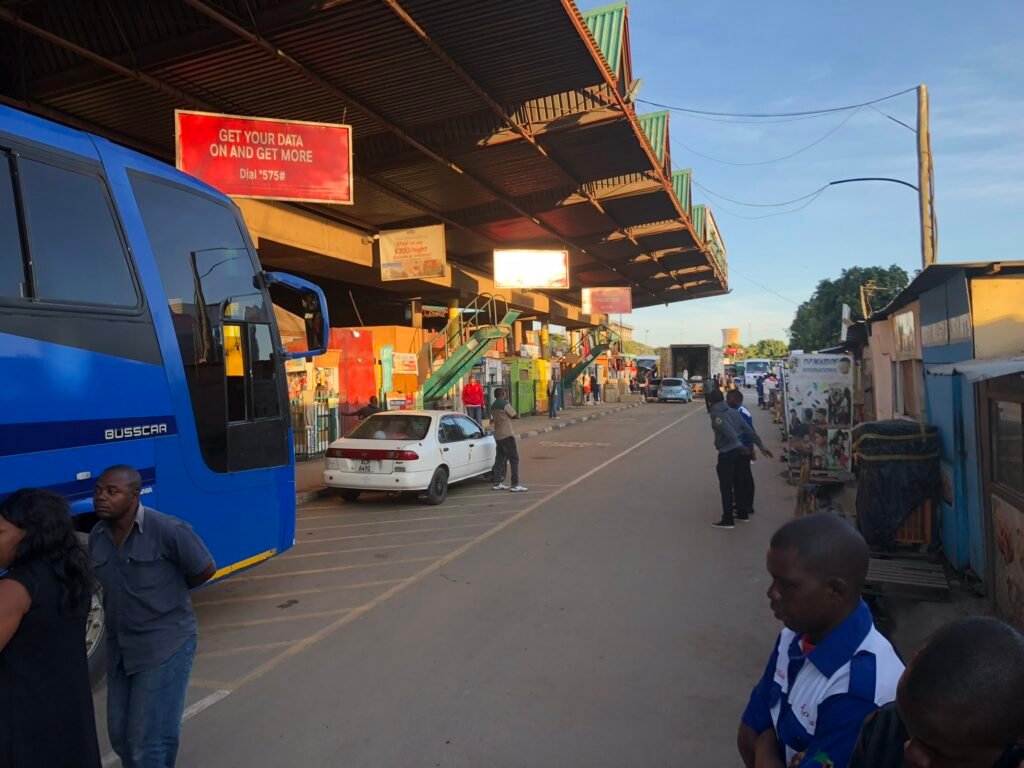
We exchanged WhatsApp numbers and promised to give him a call when we made our way back through Lusaka. For now, we were on to the next leg of our trip: a bus ride south to Livingstone, home of Victoria Falls – one of the Seven Natural Wonders of the World.
The bus ride was an adventure in itself. Packed to the brim with people – luggage and mail filled the aisle between rows of seats. Children sat alongside chickens, and stops along the way offered everything from stalls of dried fish to pay toilets. It was the kind of bus ride that constantly reminded us we were a long way from home.
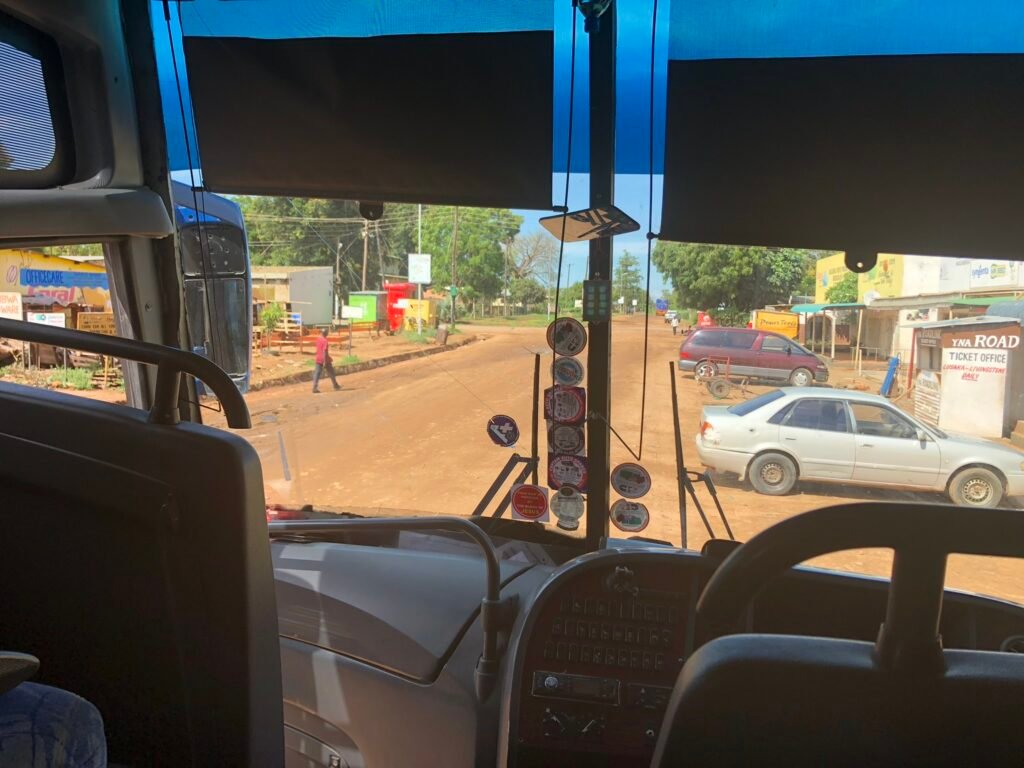
Many hours later, we arrived in the tourist town of Livingstone and made our way to Jollyboys Backpackers Hostel. This would be our basecamp for the next few days as we explored the area, saw the sights and, most importantly to me, finally did some fishing.
Fishing had quietly become my light at the end of the tunnel. Since landing in Zambia, nearly everything we’d encountered had been unfamiliar. But fishing? Fishing I understood.
Or so I thought.
Our 9 a.m. start became 9:15, then 9:30, and eventually something about Zambia began to sink in: time moves the same here, but people don’t seem nearly as concerned with keeping up with it. There was a certain Hakuna Matata to it all – things would get done when they got done. A conversation didn’t need to be cut short because the clock said so, nor did a good drive need to be rushed simply because someone was waiting at the other end.
Coming from a culture where being fifteen minutes late warrants an apology, it took some getting used to. But there was also something rather admirable about it.
Nearly an hour after our intended start, we finally climbed into the boat and pushed away from the bank. And almost immediately, there it was –
That feeling of “wild Africa” I’d been searching for since we arrived.
Fishing the Zambezi
The Zambezi River was everything hundreds of years of stories had promised. Crocodiles floated by like logs, distinguishable only by their uncanny ability to remain perfectly still while holding their place against the current. The tops of hippo heads poked from the water like small clusters of brown lily pads, staring us down with the occasional flick of an ear. And as if the scene needed anything else, a herd of elephants stood along the bank enjoying a morning shower.
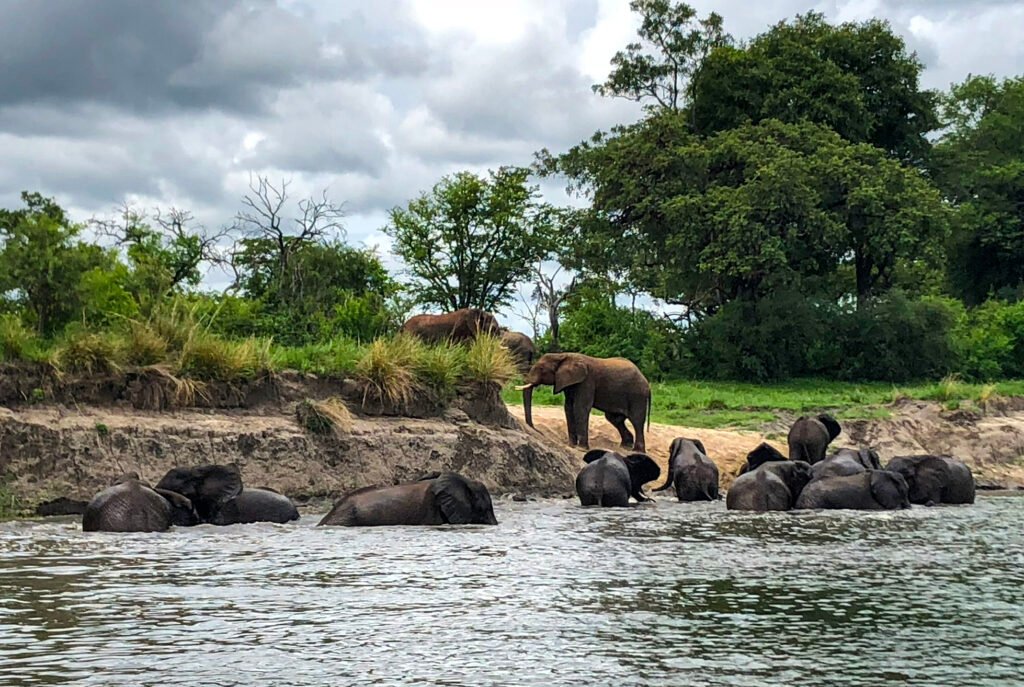
It was almost too perfect. As though the whole display had been arranged for our arrival.
Our guide had a friendly disposition, but carried himself like someone who’d spent a considerable amount of time in the bush. His eyes constantly scanned the river and banks, picking out each of the animals around us a hundred yards before we could make them out ourselves. It was the kind of visual recognition that could only come from years spent looking; knowing which log had teeth, and which pair of rocks had ears, hair and might decide it didn’t appreciate your company.
“Keep your hands inside the boat. The crocodiles love white meat.” He mentioned with a smile. “Do that – we have no problems. But if we see hippos, we move.”
I remember Alicen and me smiling at these newfound “rules.” It sounded like a line you’d hear on Disney’s Jungle Cruise, except this time the crocodiles weren’t animatronic and our guide wasn’t reading from a script. There was real danger around us, but also the reassurance of being with someone who knew the river well enough to navigate it safely.
We may not have realized it at the time, but there was something intoxicating about that combination. The unfamiliar, the slightly dangerous, and the confidence of a good guide who made you feel just safe enough to enjoy it. It was a feeling we’d spend years traveling around the world trying to find again.
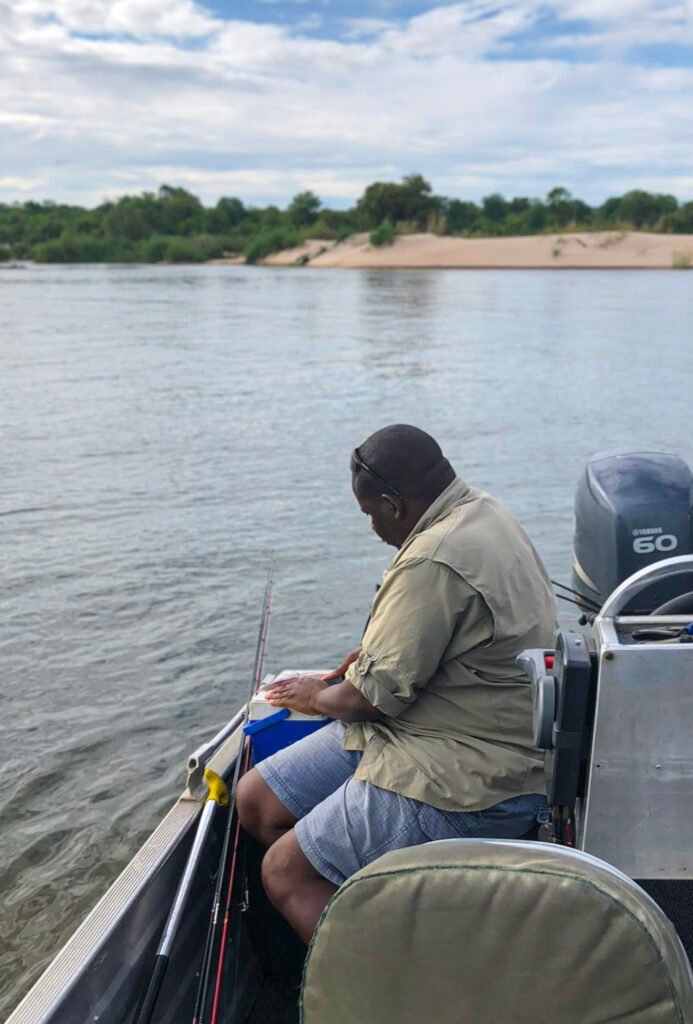
We moved a little farther upriver before drifting onto the bank of a sandy island. Our guide took a small fish (one I evidently didn’t care enough to ask the name of at the time) and cut it into narrow strips. He tied one to the shank of a #2/0 or #3/0 J-hook, leaving the strip to twist behind it on the retrieve. The result was an almost tornado-like action through the water, with the added attraction of fresh fish scent.
While he prepared our hooks, I looked upstream. On the other side of the island, a small waterfall emptied into a deep hole below.
“That looks like a good place to fish, below the falls there,” I said.
“It was,” our guide replied without looking up from his work. “Until the hippos moved in.”
As if waiting for their cue, several hippo heads rose from the water below the falls. Our Jungle Cruise continued to feel suspiciously well rehearsed.
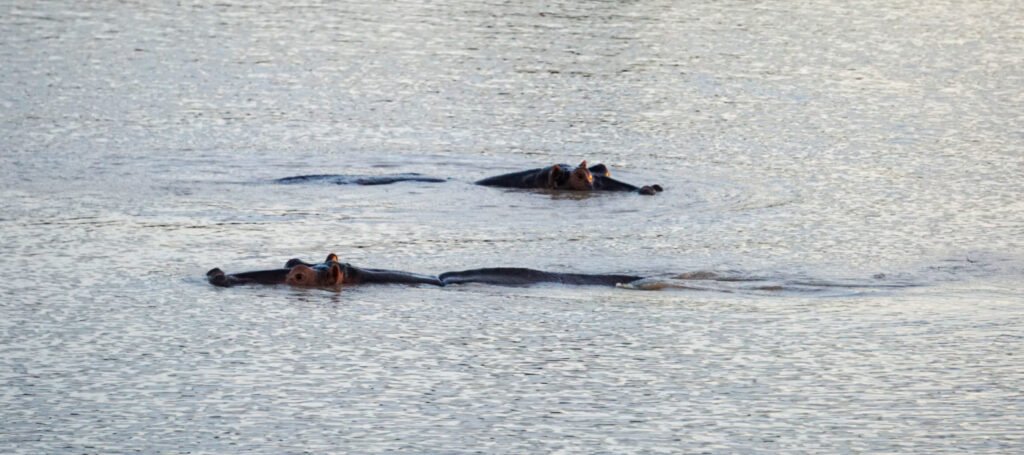
Stashing a few rocks in my pocket and a small bag of sand for my mother, we pushed off from the island, eager to send a few casts toward a hungry tigerfish. But as the hours passed, cast after cast and drift after drift came back untouched. Apparently, the tigerfish hadn’t received the same itinerary as the rest of the wildlife.
The trick during these drifts was to aim for openings along the rocky shoreline, where a tigerfish might be lying in wait just outside the current. This was the preferred method during the rainy season, rather than throwing lures. Easy enough in theory.
But much like musky fishing back in the States, getting a tigerfish to bite is only the beginning. When one finally does, you pray to the fishing gods that you’re halfway prepared for it, and that the hook finds enough purchase in that hard, bony mouth to hold.
Twice on that first day, the fishing gods gave us a chance. Twice, they took it back.
By the end of our first day, we’d learned plenty about fishing the Zambezi. What we hadn’t learned was how to actually catch a tigerfish.
Fortunately for us, we had one more day to figure it out.
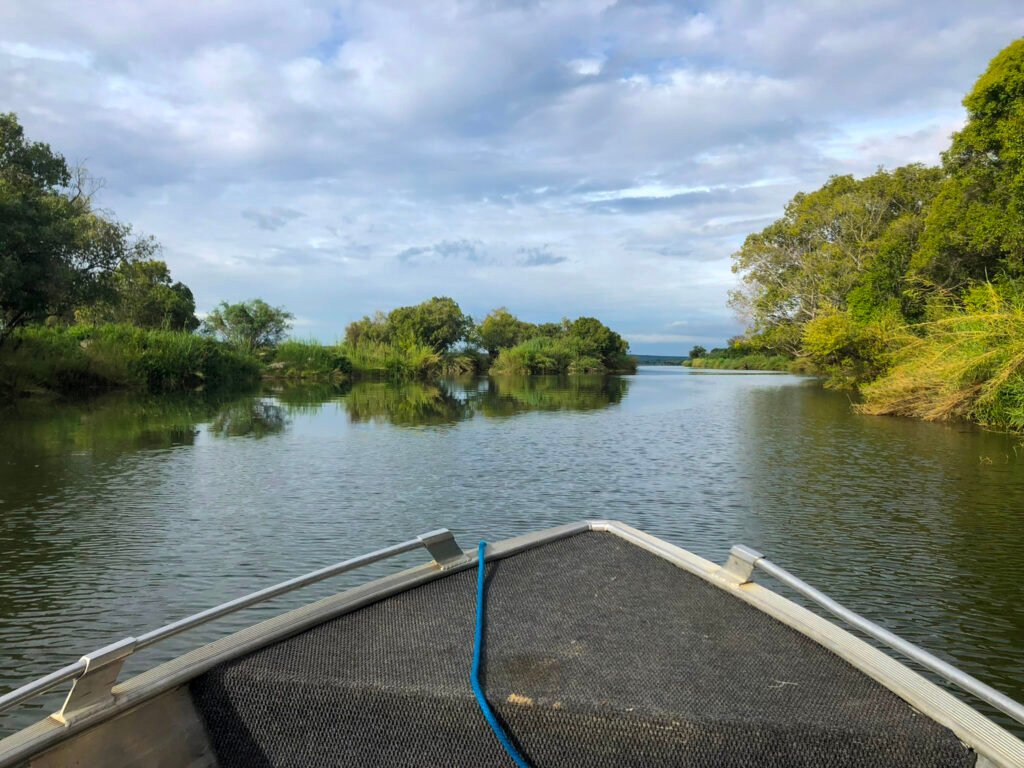
Our run in with an African tiger
As the boat drifted past on day 2, we were greeted with waves from smiling people from local villages, some of whom were in the middle of their bath time… but who, like many other Zambians, made their living from this great river. That, in itself, was a moment of mixed feelings.
On one hand, you wanted to yell out a warning about the crocodiles and hippos we’d spent the last two days carefully avoiding, wishing you could point them toward some safer source of water. But for many of these villages, there simply wasn’t one. The Zambezi wasn’t scenery. It was a resource, and relying on it meant accepting both the good and the bad.
Alicen would see the consequences firsthand during her clinical rotations. Crocodile attacks among communities along the river were common enough that nearly every village she visited seemed to have either an attack survivor or a family who had lost someone to one of these prehistoric beasts.
We continued drifting and casting, listening as our guide shared stories from when Jeremy Wade and the River Monsters crew had come to the Zambezi. Between casts, we watched more elephants along the Zimbabwean bank and Goliath kingfishers beating freshwater crabs against rocks. The fishing remained quiet, but there was certainly no shortage of things to keep our attention.
Another cast. Another drift.
Then Alicen’s rod doubled over.
Alicen held onto the rod as the fish nearly pulled her over the side of the boat. Our guide laughed, grabbing hold of her and pulling her back while calmly giving directions on how to work the fish toward us.
Looking at a tigerfish, it’s not difficult to understand where all that power comes from. In proportion to its body, the red, deeply forked tail is massive. Its fins are pointed and streamlined, and the body itself is built like a torpedo with teeth and scales. Add the current of a swollen rainy-season Zambezi, and getting one back to the boat becomes a serious undertaking.
Suddenly, the fight eased. Alicen took advantage, gaining back the line she needed until the fish finally broke the surface. Our guide was quick with the net, and just like that, it was over.
It had taken the better part of two days, but we’d done it. An African tigerfish was finally in the boat.
“Looks like it hit its head on a rock,” our guide said with a smile.
A claim Alicen still delivers a punch in the shoulder for mentioning to this day.
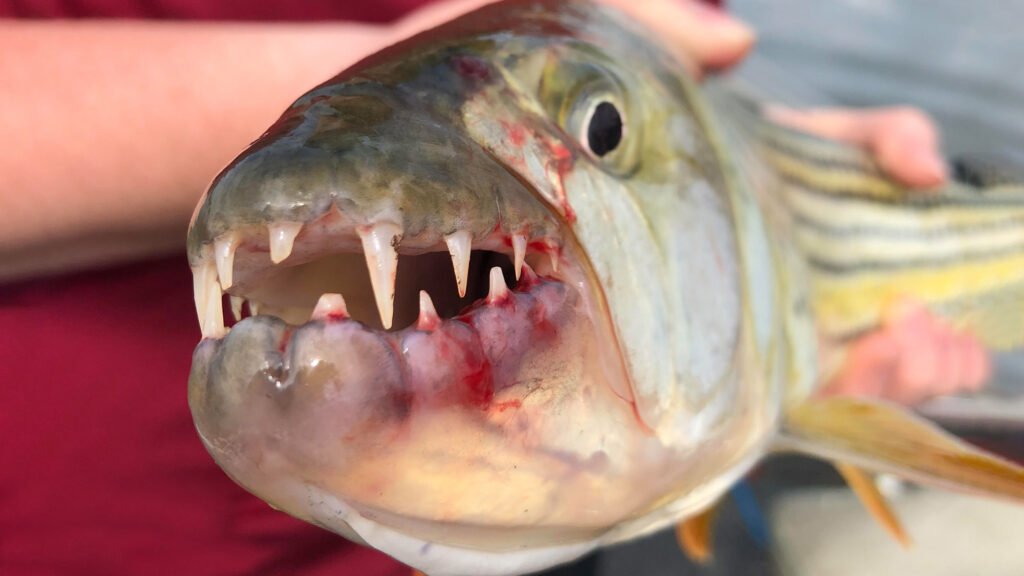
After a few photos and a closer inspection of the fish (the rock theory remains officially disputed), we slipped our tigerfish back into the Zambezi. Two days of fishing had produced only a handful of bites and a single fish in the boat, but somehow, neither of us felt particularly disappointed.
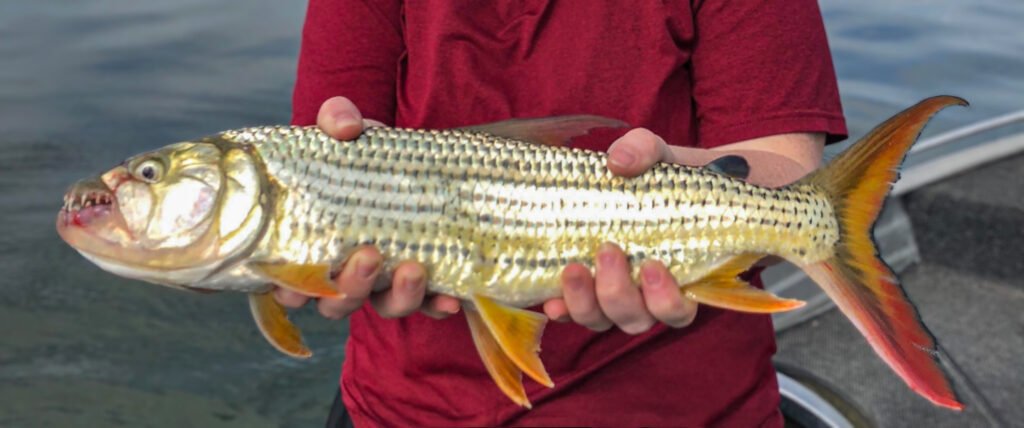
Fishing the Zambezi during the rainy season had turned out to be considerably more than the fishing trip I’d been looking forward to since we landed. It was crocodiles and hippos, elephants along the bank, a bus ride with chickens, strangers who became friends, and a different way of looking at time, travel and the world beyond what we knew back home.
Years later, after fishing in places all over the world, I still think back to those two days on the Zambezi. Not because it was the best fishing we’ve ever experienced. By any reasonable measure, one fish in two days would suggest otherwise. But somewhere between keeping our hands away from the crocodiles, moving spots for hippos and watching Alicen battle that lone tigerfish, we discovered something we’d spend years trying to find again.
Maybe that’s the trick to fishing the rainy-season Zambezi. You go looking for tigerfish and come home having caught something else entirely.