New Zealand Mountain Hunt Prep

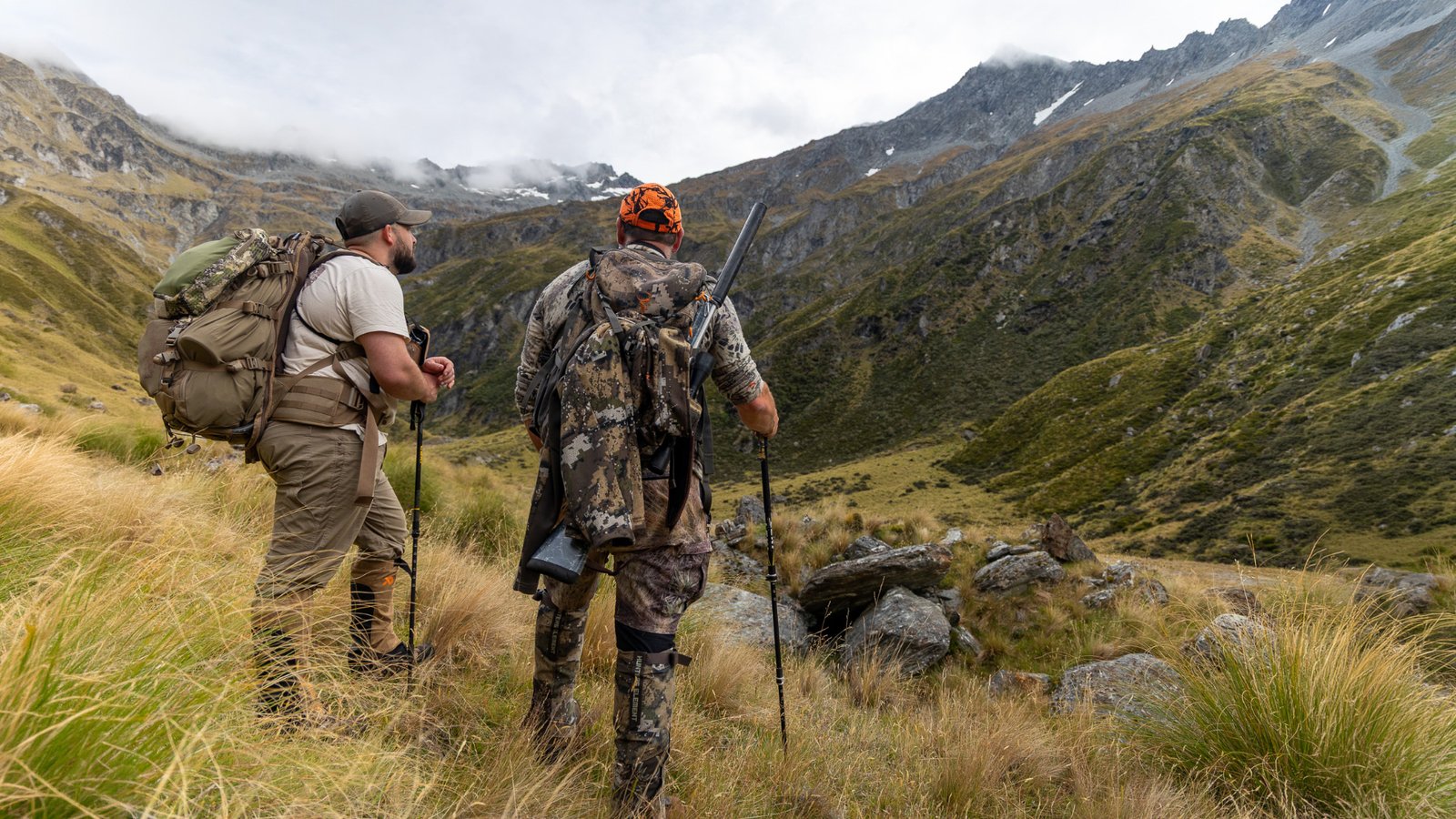
Two hunters stop to survey the valley during a hunt in New Zealand.

Hunting New Zealand’s mountains takes a little more preparation than simply throwing gear in a pack and heading for the trail. Whether you’re walking in or letting a helicopter do the first few thousand vertical feet for you, once your boots hit the ground, steep terrain, unpredictable weather and long days away from the truck mean every piece of equipment has to earn its place. From preparing your body for the climb to choosing the right pack, optics and clothing, here’s what you should consider before setting foot in the mountains.


Helwig Session Starter Kit

For the sake of keeping this from becoming one impossibly long packing list, we’ll break our mountain setup into a handful of categories: 

  • Backpacks
  • Camp gear and Meals
  • Clothing and Footwear 
  • Optics 
  • Rifle and Ammunition
  • Navigation and Safety
  • Misc. gear

That last bit is just all the little things that somehow become very important once you’ve forgotten them.

We’ll also spend some time on the one piece of equipment you can’t leave at home: yourself. Then, for anyone who would rather skip the explanations of ‘why’ and start packing, we’ll put everything together into a complete New Zealand mountain-hunt checklist at the end.

Bo Angles

But before deciding what goes in the pack, we should probably start with the pack itself.

The Backpack

Choosing a backpack for a mountain hunt starts with a deceptively simple question: How much stuff are you actually carrying?

If you’re being dropped near a Department of Conservation (DOC) backcountry hut or having camp provided by a guide, the answer may not be much different from a long day hunt. If you’re walking several days into the mountains with shelter, sleeping system, food and hunting gear on your back, however, that changes considerably.

This is where liters start to matter. So let’s begin with what not to do.

Without much idea of everything I’d eventually need to carry, I purchased an Eberlestock Modframe with a Vapor 2500. It quickly became apparent that 2,500 cubic inches wasn’t enough, so I returned it for the considerably larger Vapor 5000.

I realize my situation was a little unusual. I needed to carry sleeping bags, pads, clothing and other gear for both my wife and myself so she could carry our camera equipment. As departure approached, I realized even the Vapor 5000 wasn’t going to hold it all. One phone call to Eberlestock later, they had a Brooks 7000 at my door within two days of our flight.

Absolutely clutch. Points to Eberlestock.

If this doesn’t get you excited for a fly-in New Zealand mountain hunt… check your pulse.

The uncertainty in pack size was caused by not knowing whether we’d hunt from a fixed camp or pack up and move throughout the hunt, so I wanted the flexibility to carry everything if needed. That worked out… although I may say I experienced a bit of gear jealousy watching my Kiwi friend Ian hunt with a smaller daypack while his larger pack stayed comfortably at camp.

After a harvest, however, I appreciated having one specific component. The Modframe was lightweight and made carrying meat easy. Aside from that, the Brooks was able to compress surprisingly well when lightly packed, and a dedicated spotting-scope pocket kept one of my larger pieces of gear easily accessible, but leaving the main storage pocket for other gear.

If I were doing it again, I’d still lean towards having too much capacity vs. not enough. But if I knew we’d be hunting from a fixed camp, I’d seriously consider bringing a lightweight daypack as well.

Then again, if I did that, I wouldn’t be able to look exceptionally prepared carrying a 7,000 cubic-inch pack on a one-day stag hunt… Oh well.

Camp Gear & Meals

Planning for camping was made relatively simple thanks to our New Zealand friends, who took us along for the ride. Tents brought into New Zealand must be declared and may be inspected at customs, so we were thankful they allowed us to use one of theirs.

With shelter taken care of, we focused on compact, warm sleeping bags and inflatable foam sleeping mats. We chose the Exped Terra 15 sleeping bag, rated to 15°F, and the more moderately priced Summit Camp Plus Sleeping Mat to keep us off the cold ground and rocks. We’ve used both on camping trips since, so they proved worthwhile investments beyond this hunt.

If you’re making your own meals, an ultralight cooking system is a must. It made heating premade or just-add-water meals simple, and a single compact propane canister lasted our entire four-day hunt.

Ian (our resident Kiwi) had prepared most of our meals beforehand, largely stews and curries that could be added to rice. This kept our food supply surprisingly simple: three gallon-sized Ziploc bags of stew, a few bags of rice, plus crackers, salami and sharp cheddar for snacks and lunches. That last combination became a favorite snack throughout our two weeks in New Zealand.

Alicen and I also stashed prepackaged granola bars and beef jerky in our packs. That’s worth considering when traveling to New Zealand, where bringing food through customs comes with strict biosecurity rules. Keeping food commercially packaged made the process considerably simpler.

Electrolyte packets were another easy addition, while powdered chai, lattes and coffee became favorites when something hot sounded particularly good.

Speaking of beverages, your water source is worth considering when choosing where to camp. We could have camped higher in the mountains, closer to potential chamois, but that would have meant either melting snow or packing water.

Instead, we camped alongside a mountain stream, giving us a convenient source that, at Ian’s direction, we drank straight from.

P.S. We didn’t die or get sick.

Clothing & Footwear

You’ll want to mainly prepare for everyday wear, hunting, and something warmer for the evenings. Alicen and I kept our packing light, bringing seven pairs each of underwear and socks, two pairs of shorts, two pairs of pants, three or four T-shirts, a few long sleeves, neck gaiters and gloves, and warmer jackets.

Where possible, we chose clothing that could serve double duty. Our pants and rain jackets were colors we could comfortably wear around town or in the mountains. Considering how much rain we encountered in New Zealand, the latter became one of the smarter things we packed.

We also brought dry bags to protect our clothing in the mountains. Having a guaranteed set of dry clothes seemed well worth the extra weight. Plus, once I saw one of the colors was called Spicy Orange, I knew we’d need an extra pair for dirty clothes.

For hunting, we kept things simple: one camo hoodie, two long-sleeved merino shirts, one short-sleeved merino shirt, four pairs of merino hiking socks, and two pairs of field/work pants tough enough for the mountains but flexible enough for climbing.

Pants are actually a funny conversation between American and Kiwi hunters. Walk through a New Zealand sporting-goods store and you’ll encounter a style you probably haven’t seen much of in the States: hunting shorts.

Plenty of Kiwi hunters wear them, and while I have absolutely no evidence to support this theory, I reckon it has something to do with those old ANZAC uniforms from the First World War. Either way, you may impress a few Kiwis by showing up in shorts and leg gaiters.

Speaking of leg gaiters, we didn’t get much use out of ours despite buying them specifically for the trip. The terrain we hunted didn’t have much loose rock or debris, so we were usually comfortable letting our pants fall over the tops of our boots.

For footwear, I opted for my Merrell Moab 3s, which have served me well since Africa. Alicen wore a similar pair of Merrell women’s hiking shoes, but despite appearances, they were anything but similar. Compared to my Moabs, they lacked the aggressive tread and rigid shank that proved important while climbing.

And if, like me, you don’t understand why a rigid shank matters, let me explain.

Find a stair or street curb and place only the toes and pad of your foot on the edge, then use that foot to lift your entire body. Normally, you’d put most of your foot on each step. When climbing a mountain, however, you may be pushing your entire body upward from the front of your foot, over and over again, for hundreds of steps.

Without enough support from the boot, that’s a perfect recipe for plantar fasciitis pain. So don’t make our mistake. If you know you’ll be climbing mountains, find a sturdy pair of boots with good tread and a rigid shank. Your feet will thank you later.

Optics

When it comes to optics on a mountain hunt, three pieces of gear probably come to mind – and yes, it’s safe to say you’ll want all three: binoculars, a spotting scope and a rangefinder. Add a rifle scope, of course, if you’re bringing your own rifle.

As a Midwestern hunter, New Zealand was really my first taste of Western-style hunting: early mornings glassing slopes for game, switching to a spotting scope for a closer look, then making a stalk and using a rangefinder to determine the final distance.

With those distances constantly changing, adjustable turrets to compensate for bullet drop were another feature I hadn’t made much use of before.

I guess I come from more of an “aim at the top of the back at 300 yards” sort of background.

I reviewed my binoculars, the Vortex Diamondback HD 10x50s, separately and in greater detail in this binoculars review article here.

For my spotting scope, I shelled out a decent chunk for something that would (hopefully) last a lifetime: the angled Vortex Viper HD 15-45×65. Although it carries an MSRP of $1,049.99, I picked mine up for less than $700.

It also doubled as my long-zoom camera lens with a phone-mount adapter, saving me money and weight. For something serving two purposes in my pack, spending a little more for quality was worth it.

It pains me to admit that buying a rangefinder was, at one time, on my checklist. Despite having one sitting in my Scheels cart while it was on sale, I never actually hit Buy before leaving the country.

So I suppose the Vortex Crossfire HD will have to wait to be reviewed another day.

Rifle & Ammunition

I was thankful to borrow rifles from my friends Ian and Jack while hunting in New Zealand, as well as our guide Kitch’s rifle for red stag. All three were chambered in a cartridge popular among the hunters we encountered there, but less common back home: the 6.5 PRC. It handled longer distances well and seemed perfectly capable of putting the hammer down on just about anything in the country with four hooves.

Maybe I’m just older and larger nowadays than I was a long while ago (particularly around the middle), but the 6.5 PRC also had surprisingly manageable recoil for what it was delivering. After four days and nearly two dozen shots, I came away impressed. Although I probably won’t run out and buy one, if more mountain hunting were in my future, it’d definitely earn consideration alongside my current .300 Winchester Magnum.

As I mentioned in the optics section, I hadn’t had much experience with scopes using adjustable turrets for bullet drop. Jack’s setup took things a step further, pairing his scope with an app on his phone to account for shooting angle and distance.

Jack managed a shot at over 400 yards, right in the kill zone on a mature feral goat, so there’s definitely proof in the pudding.

Communication, Navigation & Safety
It may seem a little crazy nowadays, considering how connected we are all the time, but we had very little means of communication during our four days in the mountains. We’d paid to be dropped off and picked up four days later, and the helicopter service did just that.

Our phones stayed in airplane mode most of the time, although we had one surprise when we reached a mountain peak and found a few bars of cell reception – and even internet! It made for a pretty fun FaceTime with my parents from the top of a New Zealand mountain.

For navigation, Ian used an offline mapping app on his phone. I couldn’t tell you what it was now, but likely something like the ‘PocketMaps’ or ‘New Zealand Topo Maps’ apps you can find online. They allowed us to review the surrounding mountain range and changes in elevation while planning our climbs. Whatever app you choose, having maps downloaded for offline use is something I’d consider essential.

I also carried a Garmin inReach with a one-month subscription for emergency communication. Along the same lines, Alicen and I usually purchase a month of travel insurance when visiting more adventurous destinations.

New Zealand may not have lions, jaguars or hippos, but mountains and rivers are perfectly capable of doing you harm on their own. When you’re four days and a helicopter ride from the truck, planning for the worst isn’t a bad idea – especially when that extra safety net can cost around $60 for the month.

Misc. Gear

It’s rarely the big pieces of equipment you forget. It’s the tiny, seemingly insignificant things that become remarkably important once they’re several thousand feet below you.

For one, head coverings and lightweight gloves were invaluable in New Zealand thanks to one tiny pest that will hunt you relentlessly: sandflies. We’d purchased DEET bug spray before the trip, but the little buggers seemed to treat it like added flavor.

Eventually, Ian shared that the best defense was simply covering up as much as possible – which we did.

Though it didn’t keep my hands from looking like this by the end of the trip.

Another bit of kit we found valuable was biodegradable toilet paper tablets. Some kits came with a little metal carry tube, keeping 6-8 in easy reach, with more in a bag stashed away in my pack.

I’ll be completely frank with my process when I say that I would ‘do my duty’ while moistening one of these bad boys in my mouth, which made for a nice warmed towelette vs. an ice cold mountain stream rag caressing my undercheeks. It may not sound like the most eloquent thing in the world, but when you’re crouched amongst the tussock with only a headlamp and the clearest night sky overhead, you may thank me.

Without much experience climbing mountains, I purchased two pairs of trekking poles for Alicen and myself. What I soon learned was that this was complete overkill. Alicen never used one, and I regularly used just one to help with my heavier pack while the other three sat back at camp.

If it weren’t for Jack and Ian – who also had two unused trekking poles – ours could at least have found a second life holding up the corners of our “camp cafeteria” tarp, giving us a little more headroom underneath.

Don’t forget a few lightweight meat bags for after a successful harvest. They take up almost no room in your pack, and proved invaluable for keeping meat contained and protected while packing it back to camp.

Preparing Yourself

You can spend thousands of dollars making your pack lighter, but eventually, you still have to carry the damn thing up the mountain.

Prior to this trip, Alicen and I had spent most of the previous year preparing for a half-marathon. I’d lost 15 pounds and was running nearly 20 miles a week – right up until a month before the race, when I pulled a hamstring and discovered I’d gouged the cartilage in my knee while training with a weighted pack.

At that point I had two options: pursue surgery, or take it easy and hope to recover enough for New Zealand five months later. I chose the latter.

Do you need to push yourself that hard to prepare for a mountain hunt? I’m not sure you do. I certainly wouldn’t recommend heading into the mountains completely out of shape with no preparation, but slipping off a mountain can kill you at 120 pounds just as easily as it can at 260.

And that’s worth taking seriously.

Climbing a mountain can suck. It can also fill you with adrenaline and fear in equal measure. There were moments in New Zealand where one bad step, followed by an inability to stop yourself, could have sent you off the edge.

If you’re starting to picture Kiwis as a nation of adrenaline junkies, you’re probably on the right track. This is, after all, the country that gave us commercial bungee jumping, the jet boat, and Burt Munro – who, at 68 years old, rode a home-modified 1920 Indian motorcycle across the Bonneville Salt Flats at more than 184 mph.

But I digress…

That’s why my recommendation is simpler: know what your body can handle.

Make sure you have the leg strength to climb a few flights of stairs with a 20–30-pound pack, take a break, and keep climbing. Then turn around and walk it all the way back down. The descent matters just as much, and you’ll quickly discover how much work your quads are doing to control every step.

You don’t need to be a marathon runner. You need to be comfortable moving your body under load, know when you need a break, and be capable of doing it again the next day.

Good boots and a lighter pack certainly don’t hurt either.


Preparing for a mountain hunt in New Zealand can feel like preparing for every possible scenario at once. Some of the gear we brought proved invaluable, some never left camp, and a few things we probably could have done without entirely. That’s part of the process. Until your boots are actually on the mountain, it’s difficult to know exactly what the terrain, weather and hunt will ask of you.

If there’s one thing I’d take away from our experience, it’s to prepare for flexibility. Pack light where you can, spend money where it matters, know what your body can handle, and leave yourself enough room to adapt when the plan inevitably changes. You probably won’t get everything right the first time – we certainly didn’t – but hopefully our mistakes can save you from making a few of your own.

With that said, here’s everything we’d consider packing for a New Zealand mountain hunt. And good luck with your future hunt!

New Zealand Mountain Hunt Packing List

Backpack & Storage

  • ☐ Multi-day hunting backpack
  • ☐ Lightweight daypack (optional for fixed-camp hunts)
  • ☐ Pack frame/meat-hauling system
  • ☐ Dry bags for clothing
  • ☐ Extra dry bag for dirty clothing

Camp Gear & Meals

  • ☐ Tent or shelter
  • ☐ Cold-weather sleeping bag
  • ☐ Insulated/inflatable sleeping mat
  • ☐ Ultralight stove/cooking system
  • ☐ Fuel canister
  • ☐ Cooking/eating utensils
  • ☐ Premade or just-add-water meals
  • ☐ Rice or other lightweight meal bases
  • ☐ Crackers, salami & hard cheese
  • ☐ Granola/energy bars
  • ☐ Beef jerky
  • ☐ Electrolyte drink packets
  • ☐ Powdered coffee, chai or other hot drinks
  • ☐ Water filter or purification method
  • ☐ Water bottles/bladder

Clothing

  • ☐ Everyday T-shirts
  • ☐ Long-sleeved shirts
  • ☐ Shorts
  • ☐ Pants
  • ☐ Underwear
  • ☐ Everyday socks
  • ☐ Warm jacket
  • ☐ Rain jacket
  • ☐ Camo hoodie
  • ☐ Long-sleeved merino shirts
  • ☐ Short-sleeved merino shirt
  • ☐ Merino hiking socks
  • ☐ Durable, flexible field/work pants

Footwear

  • ☐ Mountain-capable hiking boots
  • ☐ Rigid/supportive boot shank
  • ☐ Good, aggressive tread
  • ☐ Gaiters (terrain dependent)

Optics

  • ☐ Binoculars
  • ☐ Spotting scope
  • ☐ Spotting-scope tripod
  • ☐ Rangefinder (and actually hit “Buy” before leaving)
  • ☐ Rifle scope
  • ☐ Phone-to-spotting-scope adapter (optional)

Rifle & Ammunition

  • ☐ Rifle (unless provided)
  • ☐ Appropriate hunting ammunition
  • ☐ Rifle sling
  • ☐ Scope with adjustable turrets (if your setup calls for it)
  • ☐ Ballistics app/data
  • ☐ (Confirm zero before hunting)

Navigation, Communication & Safety

  • ☐ Phone
  • ☐ Offline maps downloaded before departure
  • ☐ Charging cable
  • ☐ Portable battery/power bank
  • ☐ Garmin inReach or other satellite communicator
  • ☐ Active satellite subscription
  • ☐ Travel insurance
  • ☐ Emergency contact information

The Little Stuff

  • ☐ Headlamp
  • ☐ Spare batteries
  • ☐ Head covering
  • ☐ Lightweight gloves
  • ☐ DEET/insect repellent
  • ☐ Biodegradable toilet-paper tablets
  • ☐ Carry tube/container for toilet tablets
  • ☐ Trekking pole(s)
  • ☐ Sunglasses
  • ☐ Sunscreen
  • ☐ Basic toiletries
  • ☐ Small first-aid kit
  • ☐ Knife/multitool
  • ☐ Trash/Ziploc bags

Before You Go

  • ☐ Train while carrying a 20–30 lb pack
  • ☐ Practice sustained uphill walking
  • ☐ Practice walking back downhill under load
  • ☐ Break in your hunting boots
  • ☐ Test your pack fully loaded
  • ☐ Test your stove/cooking system
  • ☐ Download offline maps
  • ☐ Charge and test electronics
  • ☐ Activate/test satellite communication
  • ☐ Confirm rifle zero and ballistic data
  • ☐ Check current New Zealand biosecurity requirements
  • ☐ Declare applicable food and outdoor equipment on arrival
  • ☐ Know what your body can handle