Vortex Diamondback HD

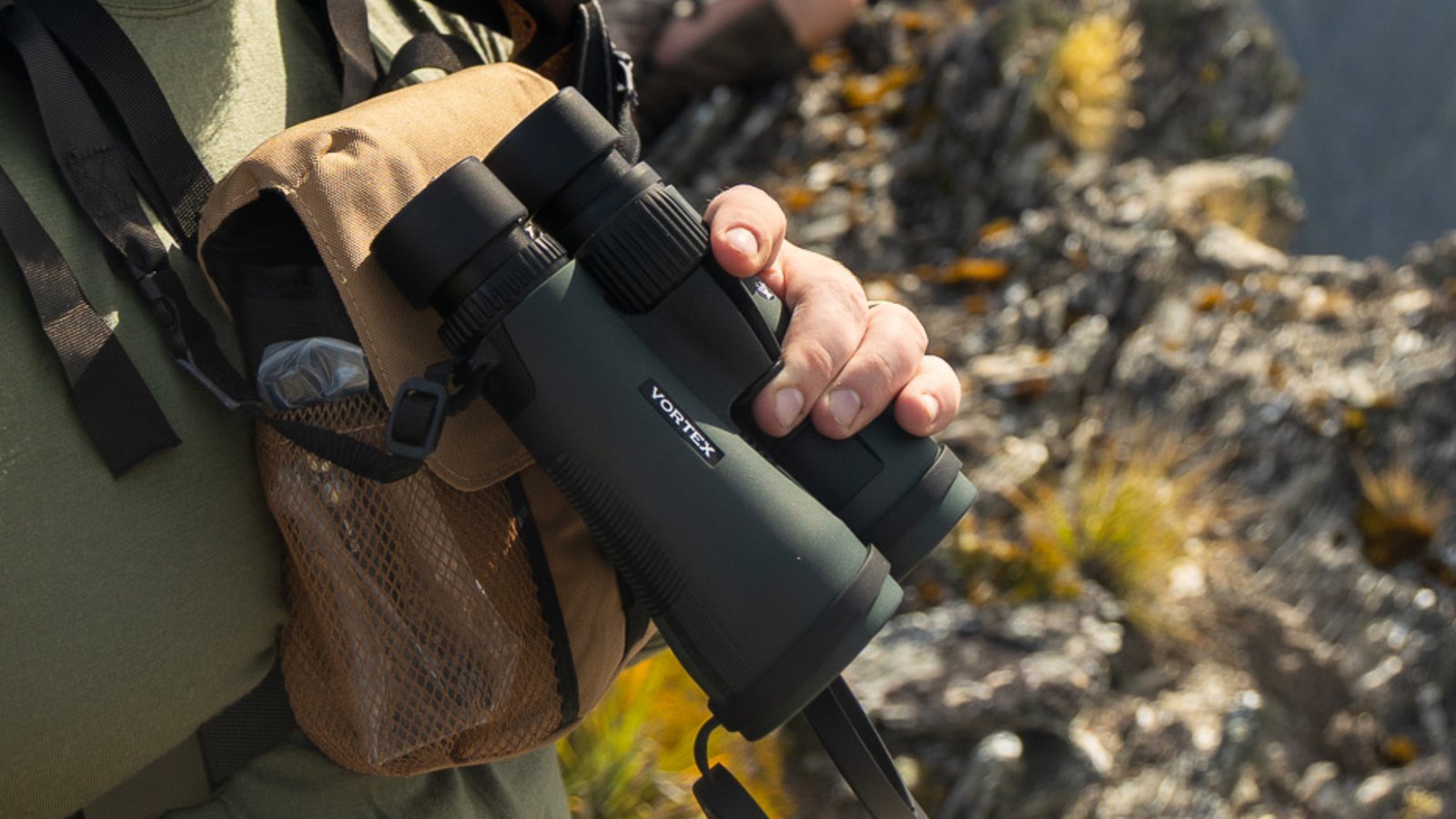
A pair of Vortex Diamondback HD Binoculars.

A good pair of binoculars can become one of the most-used pieces of equipment in an outdoorsman’s pack, but good glass can also get expensive in a hurry. The Vortex Diamondback HD 10×42 binoculars promise solid optical performance, field-ready durability, and a price that doesn’t require taking out a second mortgage. We put them to work hunting the mountains of New Zealand to see where they shine, where they don’t, and whether good glass really needs to cost four figures.


Key Specifications

Magnification: 10x
Objective: 50mm
Weight: 30.0 oz
Field of View: 315 ft @ 1,000 yd
Eye Relief: 17mm
Close Focus: 6 ft
Waterproof/Fogproof: Yes
Included Harness: Vortex GlassPak
MSRP: $359.99
Purchase Price: $269.99 (Amazon)

Helwig Session Starter Kit

Before getting too far into this review, it’s probably worth explaining where my perspective comes from. I don’t have a cabinet full of expensive optics, nor have I spent decades comparing one piece of glass against another. What I do have is nearly 10 years of experience in product design, where evaluating build quality, ergonomics and how people interact with physical products has become something of second nature.

So while I may not be the person to tell you exactly how these compare with a $2,000 pair of Swarovski binoculars, I can tell you quite a bit about how they’re designed, how they feel in the hand and, hopefully, whether spending another $1,800 might actually be worth it.

My (Peculiar) History with Binoculars

New Zealand seemed like a fitting place to find out whether a pair of binoculars was worth carrying. Hunting the mountains meant endless opportunities to scan distant hillsides and spot what was, inevitably, another herd of feral goats, but potentially a fallow deer or chamois as well. A few seconds behind the glass could save us several thousand vertical feet of walking in the wrong direction.

Bo Angles
Strapped to my chest, I carried those Bushnell binoculars everywhere while hunting in KS.

Until then, my experience with binoculars had been what I assume is pretty standard for a Midwestern hunter. They spent most of the day tucked inside a backpack, hanging beside you, or around your neck until the time called for a scan around your immediate area, or the minute of glory to ensure your ‘doe’ isn’t a small buck, before pulling the trigger on whatever happened to walk out.

For most of my life, that job belonged to an $85 pair of Bushnell PermaFocus 10x50s, straight off the shelf at a local Walmart. They rode on truck dashboards, sat in daypacks and survived many a whitetail and turkey season without giving me much reason to ask for anything more.

It wasn’t until New Zealand that I (literally) weighed the benefits of my trusty, yet bulky, Bushnells. After discovering there was no modern equivalent, I decided to put my trust in my current home state of Wisconsin and purchased the Vortex Diamondback HD in a comparable 10×50.

Optical Performance – 9/10

Compared with my dusty, 14-year-old Bushnells, carried through many a Kansas whitetail and turkey season before collecting dust in storage between them, looking through the Diamondbacks felt a bit like how I imagine people who walk into freshly cleaned windows feel… right before the bonk.

The image was bright and crisp, even in less-than-ideal conditions. Hunting the mountains of New Zealand gave us plenty of opportunities to glass in low light, particularly across hillsides buried in shadow, and I never felt like the Diamondbacks struggled to give me a clear enough picture to identify what we were looking at.

And identification really was their primary job. We’d scan distant hillsides looking for life and, if something warranted a closer look, switch over to a 15–45×65 spotting scope for the fine details.

Like I mentioned before, I haven’t spent years behind high-end Leupold, Swarovski or other premium glass, so I can’t tell you how close the Diamondbacks come to binoculars costing several times more. What I can tell you is that I never found myself looking through them and realistically wishing they had the clarity of a spotting scope with six times the zoom.

Apart from finding it broken, there are few experiences quite as deflating as opening a new piece of gear only to realize… there’s no heft. That’s a balancing act when preparing for a mountain hunt, where ounces matter, but you still want a few ounces of quality in your hands to reassure you that you made a good purchase. At nearly two pounds, the Diamondback HD 10×50 handles that balance well.

The focus dial turns smoothly, the adjustable eyecups click satisfyingly into place, and nearly every surface feels considered. Molded textures provide grip, material changes are easily recognizable by touch, and even the branding uses separate inset pieces where logos could have simply been molded into the housing. From a product-design perspective, it’s difficult for me to imagine what the next tier could offer in exterior build quality beyond better glass inside.

As for durability, Vortex hasn’t exactly made it easy for me to test that firsthand. Between rubber lens covers, the padded GlassPak harness and built-in tethers, mine made it through New Zealand with little opportunity for abuse.

Could a lens eventually crack? I’m sure it could. But considering the amount of protection Vortex provides straight out of the box, if you somehow manage to destroy a pair under normal use, dare I say… I may personally chalk that one up to user error.

Comfort & Ergonomics – 8/10

Overall, the Diamondback HD 10×50 is comfortable to hold. Differences in materials and textures make contact points easy to recognize by feel, while grooves molded into the sides provide grip and give water, sweat and debris somewhere to go. Your skin, or the material of a glove, also deforms slightly into those grooves, creating mechanical resistance against slipping.

One detail I particularly appreciate is the pair of grooved thumb pads underneath. You’d hardly notice them in a product photo, but your thumbs seem to find them naturally once the binoculars are in your hands.

At nearly two pounds, your arms may eventually start to shake, but tucking your elbows into your sides buys you a few more minutes of freehand glassing. Propping on a walking stick or tripod can take the weight out of the equation almost entirely. So why complain?

My one ergonomic criticism came unexpectedly while borrowing our guide’s Leupold 10x42s in New Zealand. Despite their smaller objective lenses, the bodies were wider where my hands naturally gripped them, and I immediately noticed how much less effort it took to hold them.

Here’s the short design lesson: point your hands down and relax them. They’ll naturally form something resembling a loose “C.” Put a cylinder of the right diameter inside that C and your fingers can largely rest around it. Make that cylinder narrower or wider, and your muscles have to contract to maintain the grip. Do that long enough and your hands begin to tire.

The Diamondback 10x50s have a long, slender profile that tapers almost like a bull horn, forcing my hands to contract around the narrower sections. If Vortex carried more of the wider diameter through the body, I think they’d be even more comfortable during extended glassing.

Anyway, thanks for listening to my TED Talk.

Ease of Use – 8/10

If there was one area where the Diamondback HD and I didn’t immediately see eye-to-eye, it was ease of use. Admittedly, some of that blame probably belongs to me.

I’ve spent most of my hunting life behind those Bushnell PermaFocus binoculars. The beauty was right there in the name: there was no focusing. Deer walk out, binoculars come up, deer get big. Easy enough process, even for a caveman.

The Diamondbacks, like most conventional binoculars, require a little more participation. The center focus dial is smooth, conveniently placed and easy to adjust while they’re against your face. But after more than a decade without needing one, even that extra step became noticeable while constantly scanning different distances in New Zealand.

Focusing, however, wasn’t what wore on me. It was everything surrounding it.

The included GlassPak is a great piece of kit. It’s protective, in reach, comfortable and stays remarkably out of the way while hiking. But combine it with the tethered lens covers and suddenly there’s a process: open the pack, pull out the binoculars, remove the covers, find focus, look… then do everything again in reverse.

Once or twice? Who cares. Do it dozens of times while scanning mountainsides all day, and I started questioning the hassle.

That’s ultimately the tradeoff. Vortex prioritizes protection, while my history with binoculars spoiled me with simplicity. By the end of the trip, I preferred something in between: keep the excellent GlassPak and its tethers, lose some of the ceremony surrounding the lenses, and accept that every once in a while I might have to clean my glass.

After all, they included a lens cloth for a reason.

Features & Accessories – 10/10

For all my complaining about the extra steps involved in getting these binoculars in front of my eyes, it’s difficult to fault Vortex for what you get in the box. The Diamondback HD feels less like a standalone pair of binoculars and more like a complete system.

Vortex includes its GlassPak chest harness, comfort neck strap, tethered objective lens covers, rain guard eyepiece cover and lens cloth, with built-in tethers keeping the binoculars attached to the harness while in use. Did I use every bit of it? Well… sort of? But I’d much rather receive a lens cover and decide I don’t need it than discover I wanted one and have to buy it separately.

If there’s one accessory I would have liked included, it’s a tripod adapter. The 10x50s are already tripod-compatible, but Vortex sells the adapter separately, from the $29.99 Sport Binocular Adapter to the considerably less friendly $99.99 Pro version.

I understand its more of a western-style of hunting to even consider using a tripod with binoculars, so I can’t fault them for not making it a default inclusion. Considering everything else straight out of the box, it’s difficult to complain too loudly. But if you’re going to leave me one empty spot on the accessory checklist… naturally, it’s going to be the one thing I actually wanted.

Value – 10/10

Are there better binoculars? Almost certainly. There are also binoculars that cost more than some of the rifles people carry underneath them. I don’t have enough experience behind premium glass to tell you exactly what another $500, $1,000 or $2,000 buys for your eyes.

What I can tell you is that during our hunt in New Zealand, I never encountered a situation where I felt spending that extra money would have changed the outcome. The Diamondbacks showed me what I needed to see, when I needed to see it.

For $269.99, I’m not sure what more I could reasonably ask for.

Who Are They For?

What became apparent after a few days in the mountains was that our binoculars and spotting scope served two very different purposes. The Diamondbacks weren’t there to inspect an animal in fine detail. They were there to find one.

We’d scan distant hillsides for movement, color or anything else that suggested life. Once something appeared, the 10x50s gave us enough magnification to identify what we’d found before pulling out the spotting scope for a closer inspection.

That makes the Diamondback HD 10×50 particularly well suited to hunters who spend a lot of time scanning open country, mountainsides or field edges, especially around dawn and dusk where the larger 50mm objective can be useful. They’re also a compelling step up for someone like me, coming from inexpensive hunting binoculars and wanting better glass without immediately jumping into four-figure optics.

If your priority is shaving every possible ounce from a mountain pack, the smaller 10×42 may make more sense. Likewise, if you spend hours judging antlers or picking apart animals at extreme distances, you’re probably already shopping in a different class of optics.

But for the hunter who needs to find an animal, identify it and decide whether it’s worth getting a better look, the 10×50 Diamondbacks fit that role remarkably well.

Final Verdict – 9/10
Optical Performance – 9/10
Build Quality & Durability – 10/10
Comfort & Ergonomics – 8/10
Ease of Use – 7/10
Features & Accessories – 10/10
Value – 10/10

Overall – 9/10

The Vortex Diamondback HD didn’t make me rethink what binoculars could be. And at this price, I don’t think they’re supposed to.

They spent several days bouncing around the mountains of New Zealand, giving me a clear look at distant hillsides without becoming something I had to worry about carrying or protecting. My biggest complaint was simply the ceremony involved in getting behind the glass: harness, covers, focus, glass… then do it all again in reverse.

The GlassPak did exactly what it was supposed to do. I’m just not convinced I need my binoculars treated quite so politely.

I’ll be completely transparent (potential optical reference) that I don’t have enough experience behind high-end glass to tell you what another $1,000 would buy. What I can tell you is that I never found myself wishing these were more than what they were.

For the $269.99 I paid, the Diamondback HD 10×50 gave me everything I needed from a hunting binocular, and very little I didn’t.