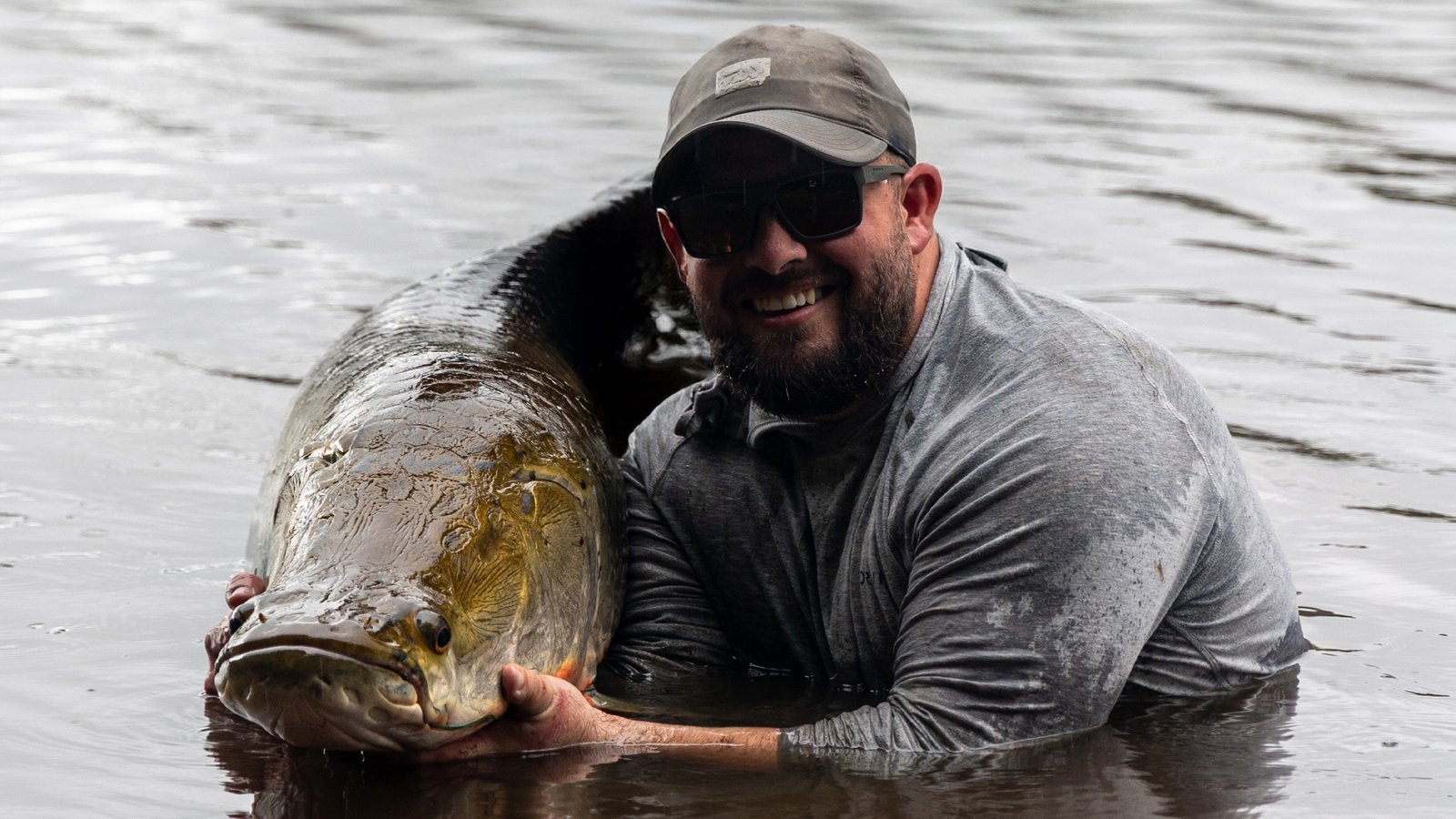
Some fishing trips start with a destination. This one started with the dream of a record. Deep in the Amazon lives the Arapaima, one of the largest freshwater fish on Earth. And on this trip, we’re heading south with hopes of putting a world-record fish on the shore. Before that can happen, though, there are rods to rig, tackle to test, travel logistics to solve, and a whole lot of preparation for a fish capable of making even heavy equipment look inadequate.
A Rabbit-hole leads to Fish
This mission started in the same fashion that many of my ventures begin: down a rabbit hole.
I had spent far too long scrolling through IGFA world records while procrastinating some other task I undoubtedly should have been doing. Payara led to piranha. Piranha led to peacock bass. Before long, I was several pages deep into the freshwater record books and beginning to notice a pattern.
- Payara all-tackle world record: Bill Keeley, United States
- Black Piranha all-tackle world record: Russell Jenson, United States
- Butterfly Peacock bass all-tackle world record: Antonio Campa G., United States
- Arapaima all-tackle world record: Jakup Vagner, Czech Republic
The names and species changed, but one detail seemed remarkably consistent.
“Wait… are none of these records held by locals?”
I sat back, and memories from our first trip to Guyana started coming to mind.
“Ooo, Keitus, that looks like a duck. What kind of duck is that?” Alicen or I would ask.
“…It is a duck.”
“Wow, what a beautiful butterfly. What kind of butterfly is that?”
“…It is a butterfly.”
Whether it was our desire to keep a conversation going or simply our quest to know a little bit about everything, the theme became pretty clear. We wanted names. Species. Facts. Keitus, on the other hand, seemed perfectly content knowing that a duck was a duck and a butterfly was a butterfly.
In fact, if it weren’t for some explorer coming along determined to identify, catalogue and add everything to a list, many of these bugs, birds, fish, plants and animals would simply continue on existing, seemingly unconcerned that nobody had bothered to distinguish one from another.
Sometimes, it takes someone from the outside looking in to recognize that what another person sees every day might actually be extraordinary. Not because the people living there don’t appreciate it, but because to them, it’s simply part of home.
And sometimes, those ordinary things are worth traveling halfway around the world to pursue.
I remember running upstairs to my wife, something she’ll tell you happens far too often, and announcing that I knew exactly what the goal of our next fishing trip to the Amazon would be.
We were going to get our friend & guide, Keitus, an Amerindian from the Wai Wai tribe, an IGFA world record.

Next thing I know, he’s handing me off a Caiman he put to sleep like a chicken. Big scaly dogs.
Getting Hooked on a World Record…
Once you’ve set your sights on a goal like this, you’re almost immediately hit with the first big dose of reality:
But catching the fish, as it turned out, was only one part of the problem.
“Well, how are you actually going to do that?”
I had no doubt the tackle we’d used on our first trip could handle a fish of world-record proportions.
Pairing a Penn VII 8500 Live Liner with 150-pound braid gave us nearly 40 pounds of drag, backed by line strong enough to handle that pressure and more. On that front, I felt pretty confident.

The rod, however, was one place I decided to make a change. My Daiwa Saltiga Travel Saltwater rod, rated to 120 pounds, had made the first trip and would return as a backup. But for our primary setup, I upgraded to a one-piece Shimano Grappler.
On paper, I was actually giving up about 20 pounds of line rating. In practice, I was making the trade for something I wanted more: hook-setting power.
This was an acknowledgement of a problem we’d run into with one of our first arapaima. The rod bent too much during the hookset, never giving us the firm hold we needed, and we ultimately lost the fish.
On the other hand, our reel could only produce around 40 pounds of drag. So, in concept, the rod would never feel anything close to the full force that 150-pound braid could put on its back.
That was my running theory, anyway.
But on a quest like this, catching the fish is only half the battle. Look through enough photos of how some of these giant fish are weighed, and you (like myself) may start wondering how they’re expected to make it back into the water alive. Suspending a 350-pound fish by its jaw from a rope thrown over a tree branch starts looking less like catch-and-release and more like hanging a side of beef. At that point, it may as well be ready for butchering.

Like most of my fishing trips, I have little interest in killing a specimen fish simply to put someone’s name in a record book. But the reality remains:
How do you build a contraption capable of weighing a potentially 10-foot, 450-pound fish… in the middle of the Amazon rainforest?
I got the whole Arapaima… in my Hands
I knew the crane scale would be the easiest component of this entire conundrum. They’re readily available, capable of handling the weight, and can even arrive with professional scale certification for an additional fee – an IGFA requirement for scales with ratings over 100 pounds.
But with that out of the way, my mind immediately went to keeping the fish flat. Aquariums have to transport smaller whales and dolphins somehow, so what do they use in those situations?
Essentially, a modified lifting harness. Something not entirely unlike those used for calves, supporting the animal’s weight around the belly and connecting above so it can be lifted by chain.
This could potentially work, I thought.
Reality, however, checked in again. They don’t exactly sell dolphin-carrying harnesses online. Turns out, there isn’t much of a public market for that. And while you can buy a 24-inch-wide calf harness… something designed to cradle small livestock may have a little trouble balancing the size of a 10-foot-long fish.
That’s not a mistake I particularly wanted to discover in the rainforest. Mishandling 450 pounds of angry arapaima near the bank could quickly turn into an unstoppable, and potentially dangerous, flop toward the water.
And for the fellow Spielberg fans out there… yes, you can purchase the full-size cattle harness you see in Jurassic Park. For the low, low price… of $725.

Unfortunately, my fishing-trip budget does not allow for the inclusion of a dedicated raptor-feeding apparatus.
From there, I broke the problem down to its bare minimums. It needed enough length to evenly support it. It needed enough width to wrap around it. And it needed enough strength to hold up to 500 pounds of scaly, prehistoric fish.
I searched animal-handling equipment, livestock harnesses, marine mammal slings and just about every variation of “how do you safely pick up a giant animal?” I could think to type into Google.
After all that research, my wife, Alicen, offered a considerably simpler solution.
“Why don’t you just use a foldable stretcher?”
…
Well, then.
A foldable stretcher. Wide, long, rated to 500 pounds, complete with handles… $25.

But there were still two problems. How do we connect those handles to the scale, and how do we get rid of all the excess water?
I started to think of materials we could find in the Amazon. Surely we could find two reasonably straight branches, run them along the side handles, then use rope to bring everything together at the scale. As for the water, surely we could put a few holes in the stretcher without compromising its integrity.
Then it hit me. Holes. Strong. Heavy-duty. Large.
What are those nets they use to secure cargo? … A cargo net.

82 × 50 inches. Seat belt material with a 12,000-pound capacity, heavy duty hooks on the corners… $120. Job done.
Finding something portable enough to actually lift the arapaima was surprisingly less of a challenge. I immediately thought of the weighing tripods commonly used by carp anglers throughout Europe. Scale that idea up considerably, and surely there had to be something capable of handling our needs.
As it turns out, there was.
The best option I could find was a portable confined-space tripod rated to 1,200 pounds. They’re primarily designed for rescue operations and lowering workers into places like manholes, but when combined with a winch, the basic idea was exactly what we needed. Strong, collapsible, portable… sure, we may have to distribute the load beneath the legs to keep them from sinking into the soft earth, but it was capable of lifting considerably more weight than I ever hope to see hanging from the scale.

It seemed perfect for the job. $299.99. And with that, we had the final component of our world-record contraption.
On paper, at least, we now have everything we need. The tackle is ready. The scale can be certified. The cargo net can hold considerably more fish than we could ever hope to catch, and a piece of equipment designed to lower people into manholes should, in theory, give us a way to lift the whole operation off the ground.
But if traveling to places like Guyana has taught me anything, it’s that a good plan is really just something to deviate from once you get there. Things get lost. Equipment breaks. Weather doesn’t cooperate. Fish refuse to bite. And sometimes the thing you spent weeks preparing for becomes considerably less important than whatever is happening in front of you.
So we’ll arrive prepared, but hopefully not so committed to the plan that we forget where we are or why we came in the first place. The goal is simple enough: give Keitus an honest shot at putting his name in a record book alongside a fish he’s known his entire life. If the Amazon cooperates, we’ll have everything we need to make it official.
And if it doesn’t?
Well… I suppose that’s usually where the better stories come from.
We’ll find out this September. Stay tuned.